
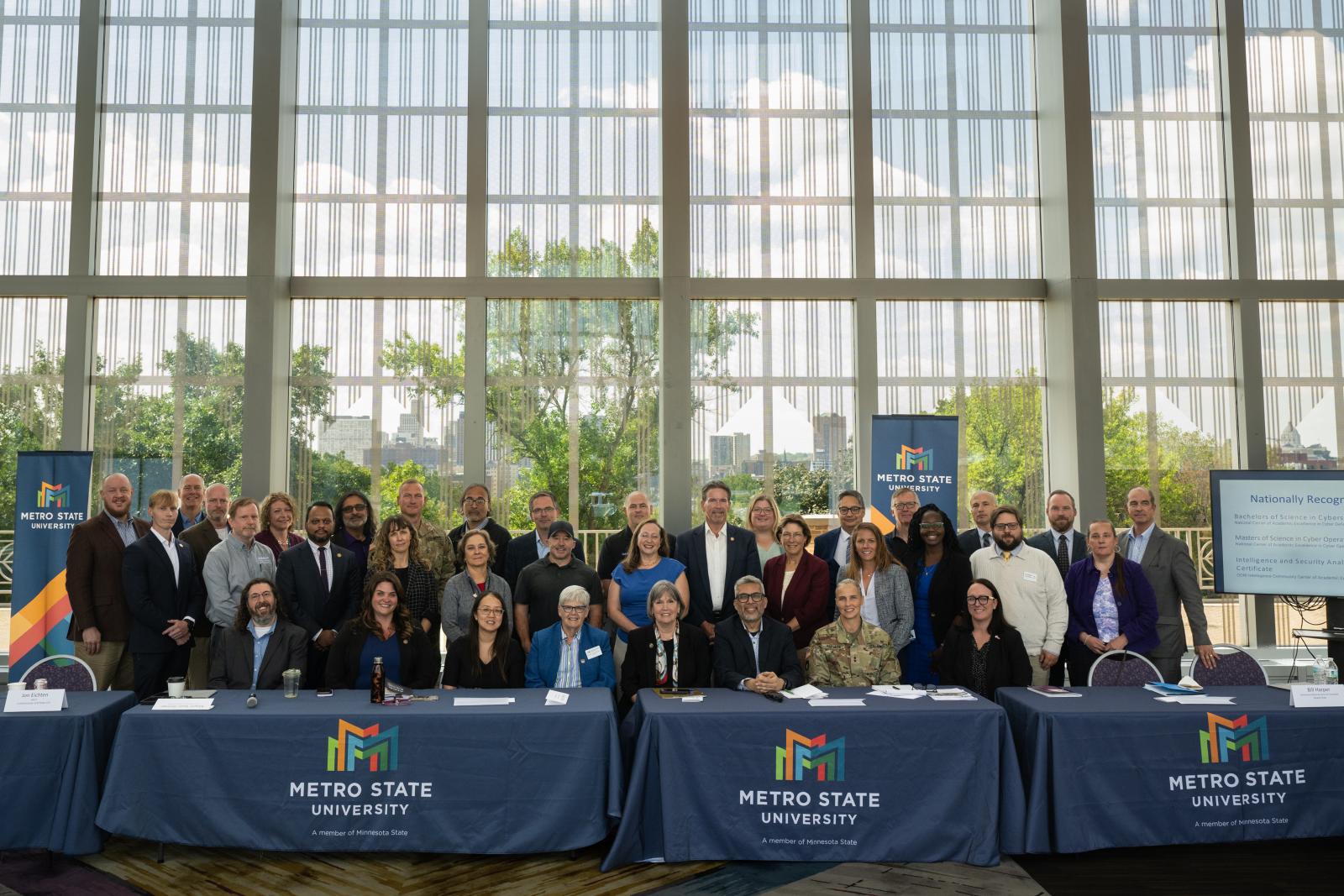
State, local, and federal leaders joined cybersecurity, emergency management, law enforcement, water-sector, and municipal representatives to discuss gaps, resources, and practical solutions for strengthening critical infrastructure resilience.
On August 27, Metro State University hosted a cybersecurity roundtable bringing together Congresswoman Betty McCollum, Minnesota state legislators, and more than 30 leaders and practitioners to discuss recent cyberattacks affecting Minnesota’s water and wastewater systems and the broader cybersecurity challenges facing critical infrastructure.
The roundtable was designed as an open working conversation rather than a formal panel or series of presentations. Participants represented state and local government, federal partners, law enforcement, emergency management, the Minnesota National Guard, water and wastewater organizations, municipal associations, cybersecurity professionals and other organizations with a role in protecting Minnesota communities.
A central theme throughout the discussion was the challenge facing smaller and under-resourced municipalities. Participants recognized that increasingly complex cyber risks require capabilities, expertise and resources that many communities cannot reasonably be expected to build and sustain independently.
The conversation focused on four interconnected areas:
- Lessons from recent incidents: Participants discussed what recent cyber incidents have revealed about the vulnerabilities and operational realities of water and wastewater systems. The conversation highlighted the importance of understanding not only traditional information technology risks, but also the unique cybersecurity challenges associated with operational technology and industrial control systems.
- Resource and capability gaps: The roundtable examined gaps in cybersecurity staffing, specialized technical expertise, OT/ICS security, funding and access to trusted technical assistance. Participants discussed the difficulties smaller communities face in maintaining the personnel, technology, and specialized capabilities needed to prevent, detect, and respond to cyber incidents.
- Training, exercises, monitoring and readiness: Participants emphasized that cybersecurity preparedness extends beyond technology. Participants identified training, recurring exercises, realistic incident scenarios, and coordination among organizations before an emergency as important components of resilience. The discussion also addressed the challenge of providing continuous cybersecurity monitoring, detection and response capabilities to organizations that may not have the staffing or resources to operate their own security operations centers.
- Coordination, policy, funding and sustainable solutions: Participants explored how state, local, federal, military, academic, industry and sector partners can work together more effectively. The conversation included the potential value of shared capabilities where building the same cybersecurity resources independently in every community may be impractical. Policy, sustainable funding, information sharing, incident response, workforce development and long-term technical support were among the areas discussed.
Moving from discussion to action: A particularly encouraging outcome of the roundtable was participants' shared commitment to keep working together and support Minnesota’s smaller, under-resourced municipalities. The event is intended to begin continued engagement rather than a one-time conversation. Follow-up efforts will include development of a policy brief identifying cybersecurity needs, gaps, recommendations, and potential next steps for policymakers.
Metro State and Major General Stefanie Horvath of the Minnesota National Guard will also lead an effort to develop a critical infrastructure cybersecurity tabletop exercise. The initiative will seek to leverage existing state, federal, local, military, industry and sector-specific resources rather than duplicate capabilities that already exist. Metro State’s cyber range and other training, simulation and technical resources may also be incorporated to support increasingly realistic technical, operational and multi-agency exercises.
Metro State as a community cybersecurity partner: The roundtable also reflects Metro State’s broader role as a cybersecurity resource for Minnesota. Beyond educating the next generation of cybersecurity professionals, the university is working to expand its role in applied cybersecurity training, exercises, community engagement, research and technical support.
Metro State is exploring additional ways to support municipalities and organizations with limited cybersecurity resources, including providing affordable security monitoring and related cybersecurity services for communities that may not be able to maintain their own security operations capabilities.
The university’s goal is to complement existing state, federal, local and industry resources and work collaboratively with partners to address gaps where Metro State’s expertise, infrastructure and students and faculty can provide meaningful support.
The roundtable reinforced a broader message: cybersecurity is not solely a technology challenge. It is also a capacity, workforce, preparedness, coordination and resource challenge—and strengthening the resilience of Minnesota’s critical infrastructure will require sustained collaboration across sectors.
Participating organizations
Organizations represented at the roundtable included the Office of Congresswoman Betty McCollum, Minnesota House of Representatives, Minnesota Senate, Minnesota National Guard, Minnesota IT Services, Bureau of Criminal Apprehension and Minnesota Fusion Center, Minnesota Homeland Security and Emergency Management, Association of Minnesota Counties, League of Minnesota Cities, Minnesota Municipal Utilities Association, Minnesota American Water Works Association, Saint Paul Regional Water Services, Ramsey County, City of Saint Paul, City of Cottage Grove, City of Hopkins, City of Braham East Central, Minnesota National Security Ecosystem, Metro State University and other partners.
Metro State University thanks all participants for contributing their time, expertise, and perspectives and for their commitment to strengthening cybersecurity resilience across Minnesota.