
America's national security increasingly depends on advanced microelectronics—and on the skilled professionals who design, manufacture, and secure them.
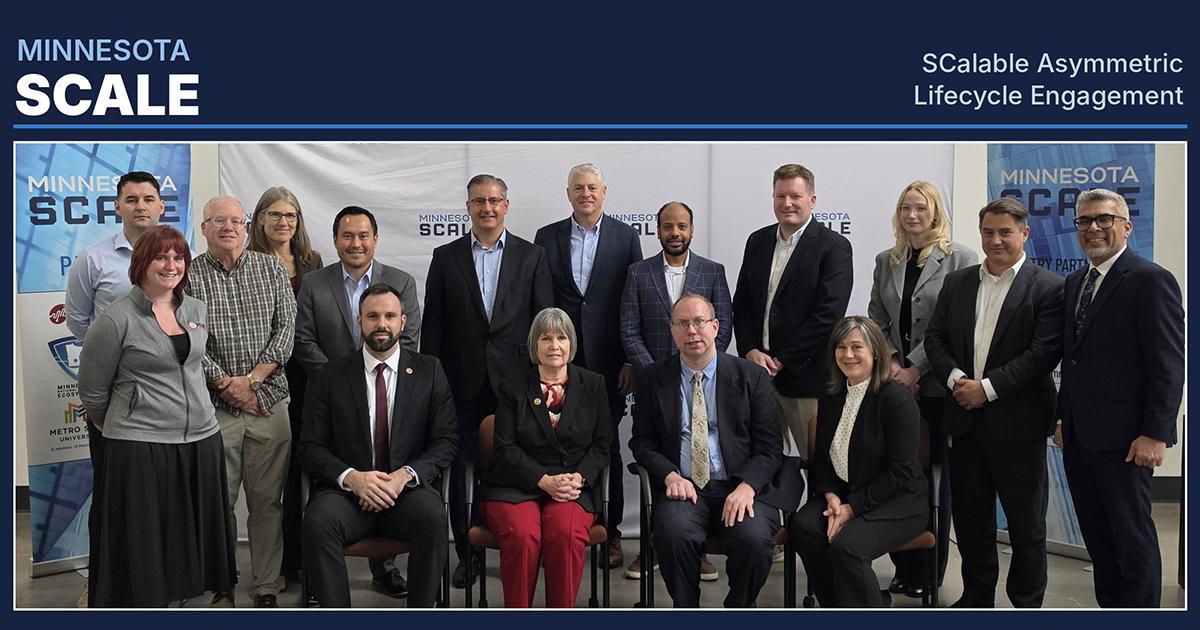
On October 14, Metro State University joined academic, industry, and national security partners to celebrate the official launch of Minnesota SCALE, marking a major milestone in a collaborative effort to strengthen the nation's defense microelectronics workforce.
The initiative is part of the Purdue University-led national Scalable Asymmetric Lifecycle Engagement (SCALE) program, supported by the U.S. Department of War and managed through the Naval Surface Warfare Center Crane Division.
Minnesota SCALE brings together the state's strengths in semiconductor research and fabrication, cybersecurity education, and advanced manufacturing to develop a coordinated talent pipeline supporting America's defense and technological leadership.
Dr. Faisal Kaleem, professor of cybersecurity and director of Cyber Programs at Metro State University, served as Master of Ceremonies for the launch celebration.
The initiative builds on conversations that began in November 2023, when Congresswoman Betty McCollum convened leaders at Metro State University to discuss Minnesota's growing role in addressing national security and workforce challenges.
A central question emerged: How could Minnesota leverage its academic institutions, technical capabilities, and industry expertise to help prepare America's future defense workforce?
Over the following years, Minnesota's academic partners advanced that vision through participation in the national SCALE program, curriculum development, student recruitment, research engagement, and partnerships with government and industry.
The October 2026 launch represents an important next step: bringing these efforts together under a coordinated Minnesota SCALE initiative focused on student development, industry engagement, and career pathways.
What distinguishes Minnesota SCALE is its integrated approach to workforce development.
Rather than preparing students within isolated academic disciplines, the initiative connects complementary capabilities across three universities and a network of defense microelectronics employers.
The academic partners contribute expertise in distinct but interconnected areas:
- University of Minnesota: Semiconductor research, microelectronics fabrication, and advanced technical training.
- University of St. Thomas: Engineering education, semiconductor technologies, and applied laboratory experiences.
- Metro State University: Cybersecurity, hardware assurance, and microelectronics supply chain security.
Industry partners include Alter Technology US, Collins Aerospace, ForwardEdge ASIC, Honeywell Aerospace, Northrop Grumman, Polar Semiconductor, SkyWater Technology, and Trusted Semiconductor Solutions.
The Minnesota National Security Ecosystem (MN-NS-ECO) serves as the coordinating organization, connecting academic and industry partners and supporting experiential learning opportunities.
Together, these organizations are creating pathways that link academic coursework, applied research, hands-on laboratory experiences, mentoring, and internships with careers in defense microelectronics.
As semiconductor technologies become increasingly sophisticated, protecting their integrity, reliability, and security is essential to national defense.
Metro State brings specialized expertise in cybersecurity and hardware assurance to the partnership, helping students understand not only how microelectronic systems operate but also how to protect them from emerging threats.
As a National Security Agency-designated National Center of Academic Excellence in Cyber Defense and Cyber Operations, Metro State is positioned to connect cybersecurity education with the evolving security needs of the microelectronics industry.
The university's contributions to SCALE include the development of coursework in Microelectronics Supply Chain Security and Hardware Assurance, research initiatives focused on trusted microelectronics, and interdisciplinary student engagement.
Metro State has also outlined plans to advance research in zero-trust FPGA architectures and establish a Hardware Assurance Lab to support applied learning in areas such as firmware security, side-channel analysis, and secure hardware validation.
These efforts reflect the university's broader commitment to preparing students for cybersecurity careers that intersect with critical technologies, advanced manufacturing, and national security.
At the heart of Minnesota SCALE is a commitment to students.
The initiative aims to provide a progression from academic learning to practical experience and professional opportunities.
A student studying cybersecurity, computer science, engineering, or a related discipline may gain exposure to semiconductor technologies through coursework, participate in hands-on laboratory research, connect with industry mentors, and pursue internships with participating employers.
For Metro State students, this creates opportunities to explore careers in hardware security, trusted microelectronics, supply chain protection, and other emerging areas of national security.
The collaboration also helps employers engage directly with universities to communicate evolving workforce needs and contribute to the preparation of future professionals.
For Kaleem, the significance of the launch extends beyond the participating institutions and technologies.
"The real measure of success will be the people we prepare, the careers we create, and the national security capabilities we strengthen," Kaleem said.
The launch of Minnesota SCALE marks a significant step in connecting Minnesota's academic strengths with the workforce needs of the nation's defense microelectronics sector.
By integrating semiconductor research and fabrication with cybersecurity expertise and industry participation, the initiative offers a collaborative approach to preparing talent for a rapidly evolving technological landscape.
For Metro State, the partnership represents another opportunity to extend its cybersecurity leadership into emerging national security domains while connecting students with meaningful career pathways.
Minnesota SCALE is more than a workforce development initiative. It is an investment in the people, partnerships, and capabilities essential to America's technological future.
With the regional initiative now formally launched, attention turns to expanding student participation, strengthening industry engagement, and translating collaboration into measurable workforce outcomes.
Metro State students interested in Minnesota SCALE opportunities can contact Dr. Sena Houeto at sena.houeto@metrostate.edu.
For additional information about the initiative, visit Minnesota SCALE.