
Metro State serves as the Midwest Regional Hub for the Economic Assessment National Center (EANC). EANC is a national initiative focused on understanding and demonstrating the workforce, economic, and mission impact of the National Centers of Academic Excellence in Cybersecurity (NCAE-C) community.
Cybersecurity education strengthens communities, prepares skilled professionals, and supports the industries and government agencies that depend on a secure digital environment. Yet the collective value of these efforts is not always easy to measure or communicate.
As the Midwest Regional Hub, Metro State brings institutions together to help tell that story. We highlight their achievements, identify shared priorities, and make sure regional perspectives shape a national understanding of cybersecurity education's impact.
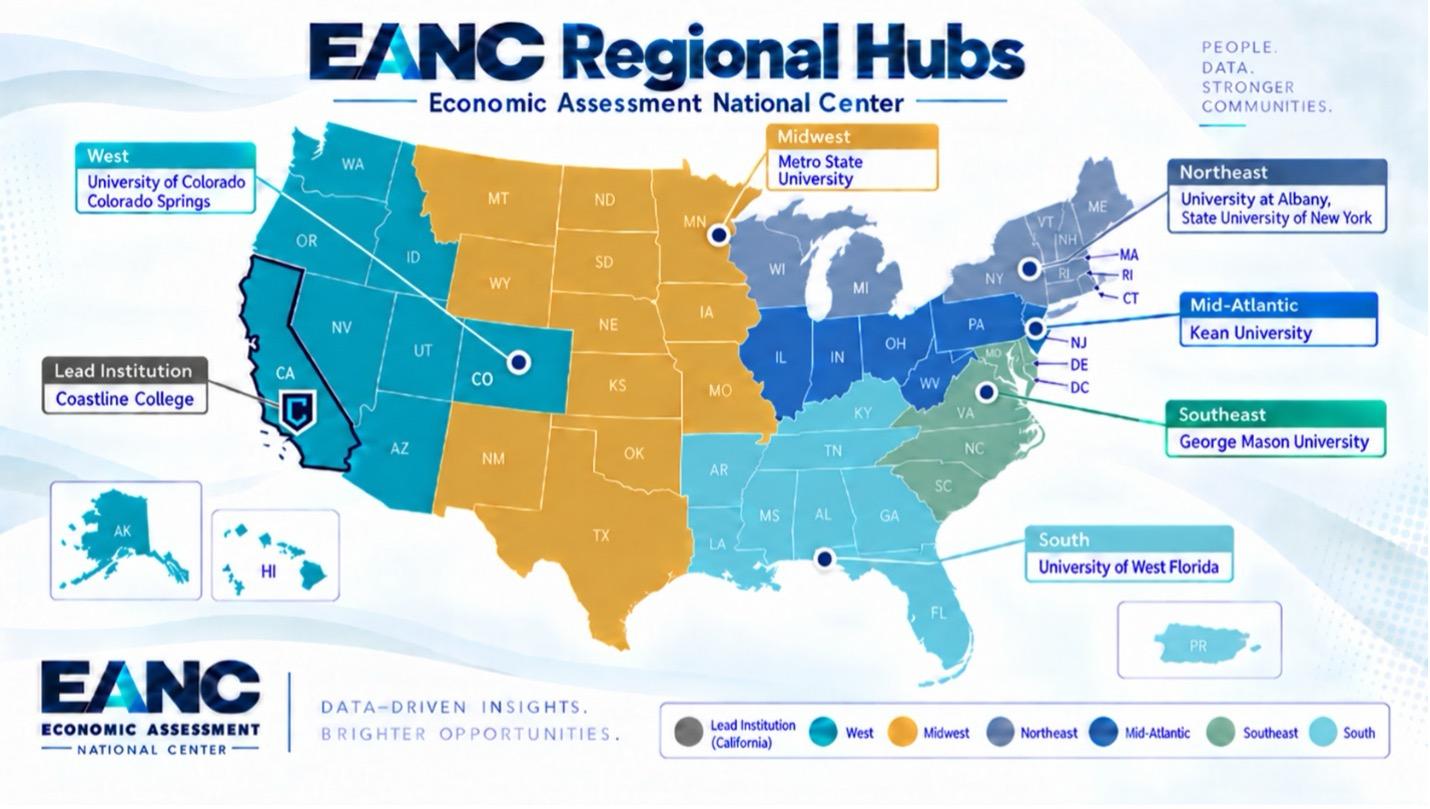
The Midwest Regional Hub serves NCAE-designated institutions across 12 states: Iowa, Kansas, Minnesota, Missouri, Montana, Nebraska, New Mexico, North Dakota, Oklahoma, South Dakota, Texas, and Wyoming.
These institutions vary widely in size, location, and mission, and they serve a broad range of students, employers, and communities. They share a commitment to preparing cybersecurity professionals and strengthening the nation's security capabilities.
EANC is a two-year initiative of approximately $1.5 million, supported through the NCAE-C program within the National Security Agency (NSA). Coastline College leads it in partnership with six universities serving as Regional Hubs. Together, they are establishing a consistent, evidence-based approach to assessing NCAE-C institutions' contributions nationwide.
Alongside return on investment, EANC examines return on mission: how cybersecurity education strengthens workforce readiness, builds institutional capacity, and advances the nation's ability to respond to evolving threats.
Our work focuses on five priorities:
A central goal of EANC is a shared Performance Measurement Framework that helps institutions demonstrate the outcomes of their cybersecurity education efforts. The framework draws together information on academic programs, graduates, industry certifications, workforce pathways, and economic contributions.
Rather than adding reporting requirements, EANC emphasizes consistent measures and effective use of data that institutions already collect. Planned national reports and data dashboards will help institutions, regional partners, and federal stakeholders understand cybersecurity education's contributions to workforce readiness, regional economies, and national cybersecurity missions.
The initiative also complements existing NCAE-C National Centers and Communities of Practice by connecting their work through a coordinated approach to assessing outcomes.
Metro State is Minnesota's only institution recognized by the NSA with dual designations as a National Center of Academic Excellence in Cyber Defense (NCAE-CD) and Cyber Operations (NCAE-CO).
Through its academic programs, the MN Cyber Institute, and established partnerships with government, industry, and education, Metro State brings extensive experience in hands-on cybersecurity education, applied research, and workforce development to its leadership of the hub.
EANC is a collaborative effort of seven institutions: Coastline College as the national center and six universities serving as Regional Hubs. Each contributes its regional relationships and expertise to a shared national effort.
|
Role |
Institution |
Lead |
|---|---|---|
|
National Lead |
Coastline College |
Tobi West |
|
West Hub |
University of Colorado, Colorado Springs |
Gretchen Bliss |
|
Midwest Hub |
Metro State University |
Faisal Kaleem |
|
Northeast Hub |
University at Albany, State University of New York |
Sanjay Goel |
|
Mid-Atlantic Hub |
Kean University |
Stanley Mierzwa |
|
Southeast Hub |
George Mason University |
Massimiliano Albanese |
|
South Hub |
University of West Florida |
Eman El-Sheikh |
Your institution's experience is part of the larger cybersecurity story. If your institution holds an NCAE-C designation in one of our 12 states, we invite you to connect with us. Join regional meetings, share your accomplishments, and help shape how the nation understands cybersecurity education's contributions.
Faisal Kaleem, PhD, CISSP
EANC Midwest Regional Hub Lead
Professor and Director, Cyber Programs
Executive Director, MN Cyber
EANC-MW@metrostate.edu | 651.793.1238
Tobi West, PhD
Principal Investigator and National Coordinator
Economic Assessment National Center, Coastline College
EANC@cccd.edu
The Economic Assessment National Center is funded through the National Centers of Academic Excellence in Cybersecurity (NCAE-C) program within the National Security Agency under Award H98230-26-1-0027.