

StarID Alert: If you are unable to log in with your StarID, please visit https://starid.minnstate.edu/ to reset or update your password.

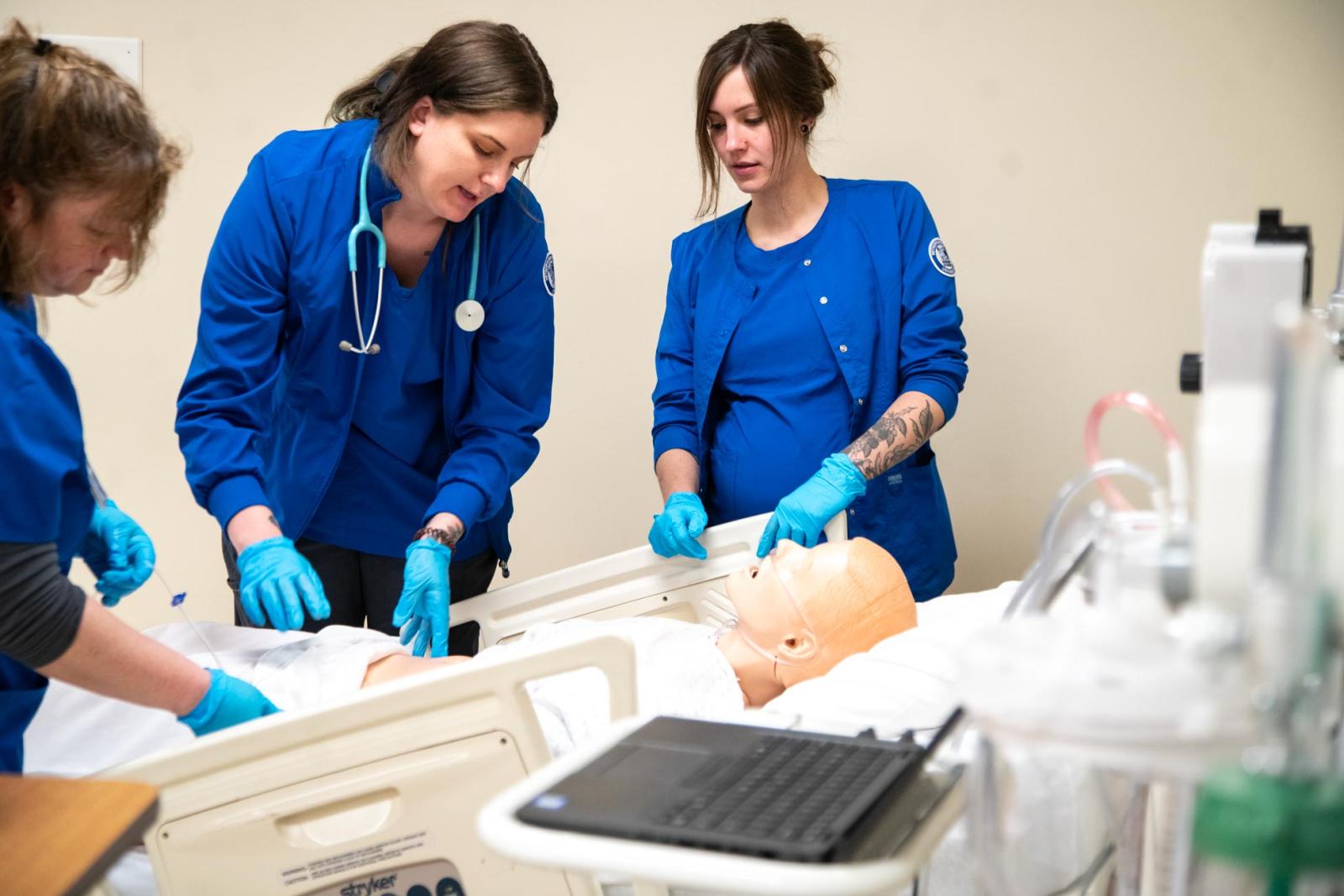
Four students work together on a nursing simulation lab

Master of Science in Nursing (MSN)

About The Program

Why choose Metro State's Entry Level MSN?

  • Move forward with a Master of Science in Nursing graduate degree rather than having to complete another bachelor’s degree
  • Significant cost savings due to undergraduate courses charged at undergraduate tuition rate (rather than the more expensive graduate tuition rate)
  • Consistent high first-time NCLEX-RN pass rates leading to licensure as a Registered Nurse (RN)
  • A high-quality program taught by nurse educators who are experts in their field
  • Holistic nursing focus, with a combination of in-person personalized instruction, hybrid, and fully online courses
  • Opportunity to transfer graduate course credits to future doctoral degree program (which is not possible with Master in Nursing programs)
  • Cohort model resulting in close bonds and support between students
  • Casual-part-time work possible even with the rigorous nature of the program
A group of nursing students work around a lab table

Time to completion and cohort start

  • Students move as a cohort through this full-time 2.5 year program, including 2 summer terms
  • One new cohort per year, starting each fall
  • Application cycle opens in August 2025
  • Next cohort starts Fall 2026

Credits and clinical experience

  • 62 credits total: 31 undergraduate, 31 graduate
  • A wide range of direct clinical experiences caring for clients across the lifespan
  • Clinical coordinator sets up all clinical experiences
  • 630 total clinical hours, including acute and chronic care, community health, and end-of-life/palliative care

Program accreditation and endorsement

  • Accredited by the Commission on Collegiate Nursing Education (CCNE)
  • A holistic nursing program endorsed by the American Holistic Nurses Credentialing Corporation (AHNCC).
  • Prepares graduates upon licensure for Public Health Nursing (PHN) Registration in the state of Minnesota.

Minimum admission requirements

  • Bachelor’s Degree in a non-nursing field
  • 3.0 cumulative GPA and a 3.0 GPA across the 4 required science prerequisites.
  • Eight course prerequisites
    • Lab science courses: Chemistry, Human Anatomy, Human Physiology, and Microbiology, each with a laboratory component
    • Non-sciences: Lifespan Development, Nutrition, Medical Ethics, Statistics

See Pre-requisites page for additional information.

Cost and financial aid

2025–26 tuition rates (per credit)

  • Undergraduate: $385.25
  • Graduate: $720.30
  • Fees: $42.30 per credit (Parking, health services, technology, student services & associations)
  • Approximate additional non-tuition fees: $2,500 (RN licensure preparation support, uniform, clinical parking, etc.)
  • Estimated Total Cost (including fees): $39,3940.65

Financial aid

  • Some scholarships available from the Metro State University Foundation and through employers or organizations such as the Department of Veterans Affairs
  • Students are encouraged to complete a FAFSA for graduate student loans
  • For more information see the Graduate Programs financial aid page, or contact the Financial Aid office at 651-793-1300

Application process

  • All application materials submitted online through NursingCAS.
  • Use this link to the program page: https://nursingcas2026.cas.myliaison.com/applicant-ux/#/login
  • Next Application deadline January 15, 2026 for priority admission, May 15, 2026 for round 2 admission, and rolling admission up to program start based on availability.
  • Check out the How to Enroll page for more information

Next steps

How to enroll

Program eligibility requirements

Applicants must meet the requirements listed for admission to the ELMSN program at Metro State University.

  • Applicants must have completed a non-nursing baccalaureate degree from an accredited college or university. Applicants whose degrees are from a non-US college or university shall have their degrees evaluated by a credentials evaluation service to determine equivalency to a US baccalaureate degree.
  • Applicants must have a 3.0 or higher cumulative GPA for all previous post-secondary study and degrees, including any courses completed that did not lead directly to a completed degree.
  • Applicants must complete the four science prerequisites of chemistry, human anatomy, human physiology and microbiology with their lab components with a grade of C or better and have a GPA of 3.0 or higher across these four requirements.
  • If an admission offer is made, the remaining prerequisites of nutrition, lifespan psychology, medical ethics, and college-level statistics, must be completed with a grade of C of better, as indicated by an official transcript submitted to the Department of Nursing, prior to the start of the program.
  • All courses must be at least three (3) semester credits, with the exception of Nutrition which must be at least two (2) semester credits.
  • Courses taken under the quarter system must be at least four (4) quarter credits for the 3 semester credit prerequisites and three (3) quarter credits for the 2 semester credit Nutrition course.
  • The statistics course must be completed no more than 4 years prior to the date of program application.

Students should carefully review the applicant policies for more specific information on transcript requirements, including criteria for transcript exclusion.

Please contact CNHS Advising (cnhs.advising@metrostate.edu) for information on filing a petition to request to exclude a transcript that meets the requirements listed in the applicant policy.

Application Process and Deadlines

Timeline and Deadlines: We are accepting applications for Fall 2026 enrollment.

  1. Round 1 Priority Admission: January 15, 2026 (10:59 p.m. Central Standard Time) deadline.
    • This is for applicants who have completed ALL of the following by the Round 1 January 15, 2026 deadline:
      • Completed a bachelor’s degree and the 4 science-lab prerequisite courses AND
      • Submitted all required application materials
    • These applicants will receive priority consideration for admission to the program.
    • Decisions for this round of admission will be communicated by early April 2026.
  2. Round 2 Admission (based on availability): May 15, 2026 (10:59 p.m. Central Standard Time) deadline.
    • This is for applicants who do not quality for round 1 priority admission for one or more of the following reasons:
      • Do not meet the requirements for completed bachelor’s degree and/or the 4 science-lab courses by the Round 1 Priority admission deadline but will have these requirements completed by the Round 2 deadline
      • Not able to submit all application materials by the Round Priority admission deadline, but able to submit by the Round 2 deadline.
    • Round 2 admission is based on space availability, with decisions communicated by the end of June 2026.
  3. Rolling Admission (based on availability):
    • If a full cohort of students is not established after Round 2 Admission, applicants will be considered for admission on a rolling basis, based on the date all application materials are received, until the cohort is full.
    • Admission decisions will be communicated immediately after the applications are reviewed.

Application requirements:

  1. Submit transcripts from all previously attended institutions, including those that did not directly lead to a degree.
    • If you attended an institution within the Minnesota State College and University system, you may upload the unofficial transcript within the Documents section of the NursingCAS application. Metro State will retrieve the official transcript for you upon an admissions decision.
    • Transcripts from an institution outside of the Minnesota State system must be official.
    • Please note: if you are applying to other Nursing programs in NursingCAS, they may require you to order an official transcript. It is important to check with your individual program(s) to see what they require.
  2. Admissions essay
    An admissions essay is required as part of the application process. Specific questions to be addressed are located in the Program Materials section of the NursingCAS application (under the “Documents” tab).

Letters of recommendation and standardized tests such as GRE and TEAS test are not required.

International Applicants:

International applicants are welcome to apply. International applicants have other deadlines to ensure all immigration requirements can be met in time for you to enroll in the desired term. For information on international applicant requirements, see the international student page.

Application instructions

Metro State University is participating in the common application for graduate programs (NursingCAS). Applications are only accepted via the CAS website.

Application Deadlines

Fall application deadline: January 15
Applications received after January 15th are reviewed on a rolling basis until April 15 or the cohort is full, whichever comes first.

CAS steps

  1. Select the term for which you are seeking admission (below), and navigate to the CAS website. Open applications include:
  2. Create or log in to your account and select the Master of Science in Nursing (MSN) program.
  3. Carefully review all instructions and complete all four sections of the application.

Specific application requirements for individual programs can be found on each program page in CAS. Carefully read the instructions that appear throughout the application pages. You can only submit your application once. If you need to update information you have submitted, please notify graduate.studies@metrostate.edu

Application fee

A nonrefundable $80 fee is required for each application.
Applications will not be processed until this fee is received.

Active-duty military, veterans, and Metro State alumni are eligible for an application fee waiver. Once your application is complete and ready for submission, please contact graduate.studies@metrostate.edu.

Please note: only one application fee waiver code is provided per applicant.

Courses and Requirements

SKIP TO COURSE REQUIREMENTS

Pre-practicum requirements

All students must meet all pre-practicum requirements prior to starting in the program and to maintain such requirements throughout the program. Information must be submitted to the Department of Nursing which may include, but is not limited to the items listed on the pre-practicum requirements page.

Student licensure

Graduates of the Entry Level MSN program are eligible to sit for the National Council Licensure Examination for registered nurses (NCLEX-RN). Graduates of the Entry Level MSN program are eligible for registration as a Public Health Nurse in the state of Minnesota after becoming licensed as a registered nurse in the state.

Licensure Exam Pass Rates

Source: Minnesota State Board of Trustees Accountability Dashboard

  • 2024 — 19 taking exam, pass rate of 95%
  • 2023 — 29 taking exam, pass rate of 86%
  • 2022 — 27 taking exam, pass rate of 89%
  • 2021 — 31 taking exam, pass rate of 97%
  • 2020 — 21 taking exam, pass rate of 90%
  • 2019 — 27 taking exam, pass rate of 100%
  • 2018 — 28 taking exam, pass rate of 96%

Requirements (62 credits)

After being accepted into the program, students will successfully complete 62 credits of nursing coursework, 31 of which are at the undergraduate level and 31 at the graduate level.

This course introduces students to the theory and concepts that serve as the cornerstone for professional nursing practice. Content builds on knowledge, skills and abilities from previous academic and work experiences to transition to the role of the professional nurse. Students will apply holistic, evidence-based clinical decision-making frameworks to provide individualized nursing care for clients with diverse cultural backgrounds and health care needs in a variety of settings. This course is part of a competency-based nursing curriculum leading to a Master of Science degree in nursing (MSN).

Full course description for Fundamental Concepts of Professional Nursing

This course introduces students to skills that serve as a foundation for professional nursing practice, with a focus on client safety. Clinical decision-making frameworks are used to promote individualized modifications for clients with diverse cultural backgrounds and diverse health care needs. This course is part of a competency-based nursing curriculum leading to the masters of science degree in nursing (MSN).

Full course description for Fundamental Concepts of Professional Nursing Lab

This course introduces students to clinical experiences that serve as a foundation for professional nursing practice. A clinical decision-making framework is used to promote holistic, client-centered care for individuals from diverse cultural backgrounds in healthcare settings with an emphasis on communication and patient safety in the role of the nurse. The successful student will be able to demonstrate beginning competence in clinical application of content related to NURS 304 Fundamental Concepts of Professional Nursing.

Full course description for Fundamental Concepts of Professional Nursing Practicum

This course focuses on the development of introductory holistic assessment skills, therapeutic communication strategies, and the identification of normal health patterns and functions for adults. Knows the skills and techniques of history taking, data collection, and holistic assessment well enough to perform and record a comprehensive health history and client assessment for an adult.

Full course description for Health Assessment

This course introduces the nursing student to human pathophysiology and disruptions in homeostasis resulting in, or as a result of, alterations in tissue or organ function due to genetic, genomic, cellular, biochemical, structural or environmental causes. Topics focus on select conditions or diseases linked to physiological systems (respiratory, cardiovascular, neurological, gastrointestinal, renal, endocrine, immune/inflammatory, hematological, and skeletal/integumentary) that occur throughout the lifespan. Emphasis is placed on integrating pathophysiology, clinical presentation, therapeutic modalities and nursing interventions for effective clinical nursing practice.

Full course description for Applied Pathophysiology

This course focuses on the foundational principles of holistic nursing care of adults throughout the health/illness continuum. Students will utilize principles of evidence based practice, theory, holism, clinical judgement, and the nursing process to identify nursing care for adult clients with select alterations in health and wellness. Emphasis will be placed on health promotion, illness prevention, and disease management for persons and populations from diverse backgrounds.

Full course description for Holistic Nursing Care of the Adult I

This clinical course focuses on the application and integration of healthcare and nursing concepts, assessment skills and interventions necessary to provide basic, safe and effective holistic nursing care to adult clients from diverse backgrounds with acute and chronic conditions. Competence Statement: Knows foundational concepts, theories, skills and the nursing process well enough to provide basic holistic nursing care to the adult client.

Full course description for Intensive Practicum I

This course introduces complex nursing skills that support care of clients in adult medical/surgical acute care clinical settings, with a focus on client safety. Clinical decision-making frameworks are used to promote individualized modifications for clients with diverse cultural backgrounds and diverse health care needs. This course is part of a competency-based nursing curriculum leading to the Master of Science degree in nursing (MSN).

Full course description for Holistic Nursing Care of the Adult Lab

This course focuses on issues related to the provision of holistic nursing care to the aging population. Emphasis is placed on health promotion, chronicity and cultural aspects of aging. Additional focus is on end-of-life care and ethical dilemmas related to the aged population. Current theories of aging are examined. Competence Statement: Knows theories of aging and concepts of health promotion, illness prevention, chronicity, culture and end-of-life well enough to identify the specialized care needs for aging clients.

Full course description for Health Promotion, Disease Prevention, and Palliative Care of Older Adults

This clinical course provides nursing students with experiences in adult mental health and pediatric care. Students provide holistic nursing care that is safe, person-centered and culturally-sensitive care for individuals and families from diverse backgrounds. Experiential learning focuses on application of evidence-based practice, clinical decision making, delegation, advocacy, interpersonal communication, and interprofessional collaboration in complex healthcare systems.

Full course description for Intensive Practicum III

This course focuses on the holistic care of clients experiencing mental health challenges. Psychiatric disorders, populations at risk, and the continuum of care delivery are addressed. Emphasis will be placed on the application of assessment skills and nursing interventions relating to psychiatric clinical conditions through didactic and simulation experiences. The effects of ethical, legal, cultural, and political factors on care of the mentally ill are examined. The Healing through Caring theoretical model is used as the basis for planning, implementing, and evaluating nursing care.

Full course description for Mental Health Nursing

This course focuses on the elements of nursing science and their interrelationships. Theories, philosophies and models that inform evidence-based nursing practice and their application to research and practice are systematically examined. Selected nursing theories are analyzed and critiqued, including their relevance to diverse client populations. The nursing metaparadigm is examined, with students reflecting on their own professional beliefs and values. Competence Statement: Knows concepts well enough to analyze and evaluate the underlying structures and elements of select nursing philosophies, models and theories, and comprehend the appropriate application of such to nursing practice.

Full course description for Nursing Science

This clinical course provides nursing students with experiences in obstetrics, hospice, and palliative care. Students provide holistic nursing care that is safe, person-centered and culturally sensitive care for individuals and families from diverse backgrounds. Experiential learning focuses on application of evidence-based practice, clinical decision making, delegation, advocacy, interpersonal communication, and interprofessional collaboration in complex healthcare systems.

Full course description for Intensive Practicum II

Course Description: This course focuses on the role of the professional nurse in working with diverse individuals and populations for health promotion and disease and injury prevention. Emphasis is placed on advocacy and social justice in working with marginalized and vulnerable populations for health equity. Population health tenets incorporate a public health nursing model of care that is holistic to identify social determinants of health, risk/protective factors, and in response uses culturally congruent evidence-based guidelines which contribute to improved health outcomes. Students explore the role of the public health nurse in emergency preparedness and crisis response. Competence Statement: Applies the public health nursing process at three levels of practice; individual/family, community, and systems to protect and promote the health of populations using a holistic, ethical, and interprofessional approach for reducing health disparities and capitalizing on asset/strengths…

Full course description for Population Health

This course provides community based clinicals for applying the public nursing process at three levels of practice: individual and family, community, and systems, using a collaborative and interprofessional approach. Emphasis will be on advocacy and social justice for marginalized populations and health equity. Students will apply the public health nursing process, focusing primarily on the community level of practice. Students will be working with at risk populations to address the social determinants of health and the provision of appropriate community based services that are valuable and culturally congruent.

Full course description for Intensive Practicum IV

This course focuses on advanced aspects of integrative nursing care to promote holistic health and wellness. Integrative concepts and principles are explored. A holistic assessment approach is utilized to assist in synthesizing inter-relationships between core course concepts. Students evaluate evidence related to integrative therapies and their application to clinical practice and self-care. Competence Statement: Synthesizes course concepts and principles well enough to apply appropriate advanced integrative approaches that promote holistic health and wellness.

Full course description for Advanced Integrative Nursing Care

This course is the second in a series of two and focuses on holistic nursing care of adults throughout the health/illness continuum with complex health concerns.¿Students will utilize principles of evidence-based practice, theory, holism, clinical judgement, and the nursing process to identify nursing care for persons and populations from diverse backgrounds with select complex alterations of health and wellness.

Full course description for Holistic Nursing Care of the Adult II

This course focuses on synthesis and application of principles and concepts in pathophysiology, pharmacology and health assessment in the analysis of health issues of adults in nursing practice. Students demonstrate clinical judgement that builds upon previous coursework in pathophysiology, pharmacology and health assessment. By understanding these principles, students will assess and anticipate an individual¿s physiologic responses to initiate appropriate independent and collaborative nursing interventions. Clinical decision-making frameworks are used to promote individualized modifications for clients with diverse cultural backgrounds and diverse health care needs. This course is part of a competency-based nursing curriculum leading to the Master of Science degree in nursing (MSN).

Full course description for Advanced Integration: Pathophysiology, Pharmacology, Health Assessment Lab

This precepted clinical capstone course focuses on coordination and provision of holistic nursing care for one or more clients. It is designed to provide students with an intensive practice immersion to facilitate transition to the role of the professional nurse. Students are precepted by an experienced nurse with on-going guidance from faculty. Students demonstrate leadership skills through collaboration and development of an evidenced-based clinically-based project. Competence Statement: Knows concepts well enough to demonstrate holistic evidence-based nursing care for complex or multiple clients across the lifespan.

Full course description for Capstone Practicum

This seminar course provides a foundation to the role transition from student to professional nurse. Emphasis is placed on synthesizing theories, principles, concepts and skills from nursing and other disciplines as a basis for implementing holistic nursing care directed toward healing in the human health experience. Students demonstrate integration of theoretical knowledge and clinical decision making in simulated complex clinical experiences and presentations. Competence Statement: Knows the art and science of the nursing discipline well enough to make the clinical judgments that ensure the provision of safe, holistic care required of an entry-level professional nurse.

Full course description for Comprehensive Care Seminar